| 6 comments ]

So there's not much subtlety in a recent comment on Jon Udell's call to experiment with local weather data and look for trends. After reading Jon's piece on using Many Eyes to determine local trends, Brendan Lane Larson, a Weather Informaticist, writes:

Your vague “we” combined with the demonstration of the Many Eyes site trivializes the process of evidence exploration and collaborative interpretation (community of practice? peer review?) with an American 1960s hippy-like grandiose dream of democratization of visualized data that doesn’t need to be democratized in the first place.

You may recognize this meme -- it's the experts vs. the amateurs story that's being peddled by Andrew Keen and others. And like most people involved in Web 2.0 endeavors, I have some sympathy for that view, but despise the frame.

And reading Jon's article and looking at that bar graph it occurred to me one thing that we consistently fail to mention in this discussion.

It's not just Experts vs. Amateurs. It's very often Experts vs. Experts in Something Else.

What do I mean? Look at this bar graph:
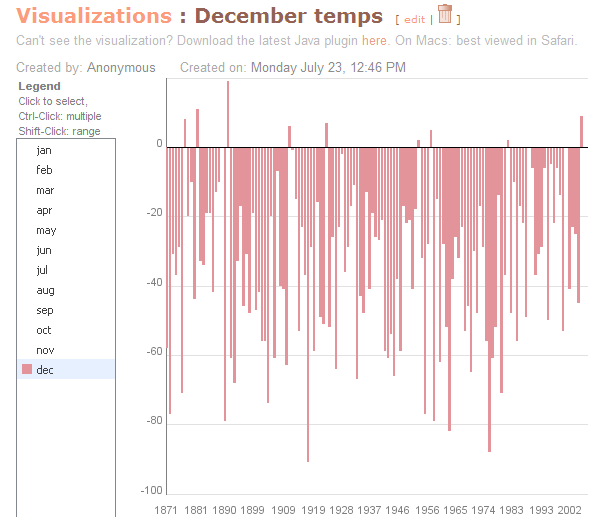


It's temperature in December . And I know nothing about weather patterns.

But of course it doesn't look like a temperature graph to me. It looks like the crazy graphs of server requests and thread lengths I'd pore over daily about two years ago when the server was crashing every couple of hours.

That's probably not helpful insight in this instance, for a couple reasons. First of all, I'm far from expert in analyzing server and nework traffic. Second of all, temperature most likely doesn't operate to rules similar to network traffic.

But what if I was an expert in analyzing network traffic? And what if, just possibly, I had models and methods unknown to the climatology crowd that could be helpful? Or what if I were a sociologist, or an options trader, or any other of a thousand professions that have developed ways to crunch data?

Could we admit that maybe, just maybe, experts in these other fields might bring a breakthrough to the table?

Think I'm wrong? The Wright Brothers were bicycle builders. The pair that cracked the DNA code weren't biologists or chemists, at least not originally: they were an ex-physicist and a former ornithology student. Douglas Engelbart, inventor of hypertext and the computer mouse (among other things) was heavily influenced by the work of linguist Benjiman Lee Whorf. Mandelbrot revolutionized market analysis, without any economics background.

The list goes on. The world is not quite as bottled up into climatologists and computer scientists as one might like to think. Certainly we must establish distinctions when it comes to authority, and we must encourage peer-review and cultivate healthy communities of practice. But if we do all that while maintaining our xenophobia, we are ignoring an important lesson. One that history has taught us again and again.

| 0 comments ]

One of the absolutely consistent features of website development (at least in my neck of the woods) is that storytelling problems are miscast as technology platform problems.

Here's a typical example. I'm currently working with a department to move them to a third party vendor, and in demonstrating a sample site one of the possible vendors shows a Hall of Fame gallery that features a video of an interview with a Hall of Fame coach. And it's cut together nicely, with some original footage and Ken Burns style photo scans.

Cue oohs and ahhs. This is something they've wanted to do for some time.

But of course, the vendor didn't produce the video. They merely put it up, a process that we could do on the current site if we had the video.

We don't have a technology gap; we have a skills gap. We tell stories about our Hall of Fame coaches already. But we don't have the internal capability to tell them in the way people now wish to hear them.

What's changed from several years ago is where we once needed writers we now need full service media producers, and where we once could control the spin of a story, we now need to lay it out there a little more naked. It's not enough to simply hire writers anymore. You need to hire a writer that can put together the sports video, take the photographs, and post it up on the web. Someone that knows how to both get the who-what-when-where-why and also how to do a simple video edit. Someone who gets the new culture of transparency and can write in the new web idiom.

In short, although I suppose every person in that vendor presentation would be shocked to hear it, you need to hire bloggers. For in the end, what would make more of a difference? Presenting the sports site on the new vendor platform? Or hiring a sports blogger instead of the average intern?

Which would build more of a following and have a greater effect on recruitment? Generate more alumni excitement? Have a greater bottom line effect?

My guess is for the majority of cases if you pit advanced technology against a compelling blogger, the blogger will always win. And organizations that begin to hire with that in mind will benefit.

| 0 comments ]

This is fascinating, to me at least. Marc (are we allowed to call him Marca?) came late to blogging, but he's clearly making up for lost time and talking to the right people.

But what I noted in his recent post was how much his view of the larger web (via Sifry) matches exactly what we've been talking about over here vis-a-vis the Inverted LMS (or really the Inverted CMS idea applied to education). Marc writes:

The first time I met Dave Sifry, over three years ago, he told me that conversations on the Internet would eventually all revolve around every individual having a blog, each individual posting her own thoughts on her own blog, and blogs cross-linking through mechanisms like trackbacks and blog search engines (such as Dave's Technorati).

The advantage of this new world, said Dave, is that each individual (anonymous or not) would be publicly responsible for their own content and in charge of their own space -- substantially reducing the risk of spam and trolls -- and the communication would flow through the links. There would still be the risk of link spam, but at least this new world would make people more responsible for their own content, and that would tend to uplevel the discourse.

I think Dave is exactly right, and the implications of this new world are very interesting.

The rest of the post is worth reading too -- it's more of a head-nodder, mostly reiterating stuff that ALL bloggers learn very quickly, but it's great to have it all in one place. And it has the neat advantage that you can send it to the non-believers with a note that says "From the guy that co-founded Netscape."

I'm saying, it doesn't hurt.

| 0 comments ]

So, this was impromptu, but if twitter history is ever written I want credit for writing the first 40 second song explicitly for twittergram.

http://tinyurl.com/2s8oee

I'll get better. It's a new format for me.

| 0 comments ]

Gardner Writes has a good critique of of my Inverted LMS post, which raises a number of important issues.

So let's say first I am both manifesto-prone and conversation-addicted, and those things generally equal out.Â

This is conversation Mike speaking.

The question Gardner poses is whether "student-centered" swings too far in the other direction:

But I’m driven to respond because the matter is not simply one of awakening from a “hasa” world into the brave new “isa” world. If only it were that simple. “Hasa” and “isa” are not alternatives. They are partners in a dance. They are both parts of the inescapable, imperfect, provisional, necessary work of conceptualization itself. Of identity.

There’s a “hasa” element in our experience that we should not reject, lest we swing from one mistake to another.

I absolutely agree on this point. The interplay between who we are and what we are contained by is inescapable.

Or rather, I should say the tension between those two models is inescapable, since we can model most things either way.

So are we entering a brave new world of isa? Partially. I heard Dave Weinberger the other day on IT Conversations, talking about his latest book, Everything is Miscellaneous. It seems related to this. One of the advantages of modern tagging systems is that we break free of having to impose a single hierarchy on things. In the world of data, you can file the spatula both in the silverware drawer and by the grill.

I think that's a really major thing, and we've only scratched the surface of the ramifications of that. And at the same time I think that the chance of hierarchy and taxonomy going away completely is exactly zero. As I said in the original post, it's too comforting. Inspired by your post, I'll clarify even further: it's too useful.

I'll give a great example -- in my free time, I co-run a pretty prominent online political community called Blue Hampshire. It's run on a piece of software called Soapblox, which allows all 600 members to post their articles on the site and comment and rank them and so forth. And compared to the blogswarms I've been a part of, Soapblox is very much a box. You're in that community or you're not.

Now would I dismantle that community and break it into 600 Wordpress blogs x-reffing each other? Not on your life. Or at least, not yet. There's a whole bunch of reasons why that would be a disaster, but I'll mention four:

1. Comfortability: People on the site very often come from DailyKos, a national site that runs similar software. They know how this system works. Why not capitalize on that?

2. Power in Numbers: As one of three managing editors of this 600 member site, I represent the community. Because we've pooled our effort here, I can get candidates to talk to us. I recently got all the Democratic campaigns to write up a short paragraph for us describing explicitly what their differences on Iraq policy were. Had we been seperate blogs, they never would have considered that.

3. Shared Identity and Unique Experience: People sometimes x-post to other sites, but what the community really appreciates is stuff written for them precisely. There's something about having something very precisely keyed to members and not available anywhere else (including one's personal blog). You see people express this feeling often in comments.

4. Policing: The nice things about boxes is you can very satisfyingly kick people out of them if they break rules of engagement.

Is all this possible in a more distributed model? Maybe. I'd say most likely. You can kick someone out of an MU aggregator by unsubscribing to their feed. You could syndicate more selectively. You could collect stats to show your bargaining power....etc.

But the point is this: the very simple model of Soapblox, for all it's faults, enabled us to become the number one blog community in New Hampshire within three months of our launch. And more importantly, it has allowed our members to have a real effect on both New Hampshire and national politics. We've involved over 600 people (that have signed up to post), and we average about 70 comments and ten posts a day. Campaigns contact us, rather than we them.

And I'll admit we couldn't have done that, on that level, using a more loosely coupled model.

At least, not yet.

There's a lot more I want to say, but I will end with this -- where Gardner says...
But the impulse of which the LMS is an institutional perversion is not, I’m beginning to think, wholly wrong. The challenge is to re-imagine school so that the boundaries can be artful, changeable, semi-permeable, and the result of creative decisions, not administrative convenience.

...I think we're in complete agreement.

 So if I know all this, why the manifesto?

Because I think 99% of people don't even know there is another way. And they can't imagine another way things might work. And frankly there's no really extant example that goes as far into the attribute model as Blackboard goes into the container model.

So while it might seem unneccesarily Hegelian, I think we need to talk about what the antithesis is, and hopefully build it. It's not always obvious, for example, how one might model a study group vs. a class using a less container-oriented approach. Part of that is doing what Gardner describes -- understanding the good things the modern LMS/CMS has done for us.

But I think the other part is building the antithesis and taking it for a spin. It's only in that way that we can really know it's efficacy, and to my knowledge no one has tried that yet.

My gut is if we do this we will find ways to deal with many of these issues -- if we give it a chance.

| 12 comments ]

I've been out of linguistics for so long that I don't know if this is still the case, but it used to be there was a distinction in some branches of cognitive linguistics between what programmers might recognize as ISA and HASA relations.

The idea is this: a giraffe "isa" animal. The zoo "hasa" giraffe.

The difference in cognitive linguistics was that "isa" relations are indexed by our brains only from the instance to the category, whereas "hasa" relations are indexed from the category to the instance.

What does this mean?

Well, consider the problem of naming all animals that you know, a standard intelligence test. Want to know what most peoples answers look like? They come in clumps:

Um...dog, cat, mouse, hamster......cow, horse, goat, chickens -- no wait, chicken's a bird right -- pig, bull.......giraffe, zebra, gorilla...

So what's going on there with those groupings? Well, the person realizes there are no downward pointers from the concept "animal" to all animals. So they do the next best thing -- they think of locations that contain contain animals (farms, zoos, etc), and then list off the animals they contain. An answer might be in clumps of domestic animals, zoo animals, animals at the circus, farm animals, and animals in the movie Evan Almighty.

Humans like containers. They are visual and reassuringly physical; they run with the grain of our general thought.

So it's no surprise that the modern LMS developed under what I would call a "container model". We "upload files to" it. We have discussions "in" it. And if the "outside world" needs to see something "in there", we give them "access".

And the students? Well, they're "in there" too. At least the piece of the student that belongs to that class is. You know, the English major slice. The part of the student that is a science minor is in another box, and the part of a student that is looking for a job or hanging out with friends doesn't have a box at all.

So here's one of the paradoxes of HASA-based LMS systems: they follow the grain of of our thought, and at the same time they profoundly fracture our experience. The unintentional message of the HASA LMS is what goes on in class stays in class -- that it is seperated zoologically from the personal and the professional aspects of a students character.

Which brings me to my point (a variation on my "student-centered" question of a few weeks ago) -- what does an "ISA-based" LMS look like? What if we moved from the container model to the tagging/syndication model, and instead of uploading something into the ENG 331A box, we kept it on the student's own site and tagged it as being relevant to his ENG 331A class and say, his professional portfolio? And maybe tagged it as a submission to the Academic Excellence Conference as well?

What if we made an "ISA" based system, and inverted the traditional LMS? What would it look like?

The answer is it's a HASA system where the student is the container, and the different courses are attributes of that student's output. Can anyone say "student-centered"?

Or "whole person education"? Or "integrative studies"?

Because that's what this is about, in spades.

Once again, in a student-centered LMS, the student contains part of the class rather than the class containing part of the student.

Too abstract? Luckily you can see what the inverted LMS of the future looks like, because.UMW is putting one together. From free materials and code. On a server that costs $6.95 a month.

I'd file such a thing under both "cheap" and "pedagogically correct".

But then, I can do that: I'm an ISA sort of guy.

| 3 comments ]

I get a wave of nostalgia when I read a John LeCarre novel. Not for the simplicity of Cold War politics or for spy novels written with a real sense of literary style, but for the physicality of the world George Smiley inhabits. Trying to figure out a particular thorny problem, he grabs a notebook, brings the rotary telephone over to the table, and between making a couple of phone calls, thinking a lot and writing a bit he comes to some conclusion.

I miss the quiet of years gone by, the unconnectedness, and when I read small passages like that a strange bit of longing for that world sweeps over me.

And while there is a certain nostalgia here, I can't help but think there is something bigger too, that we have lost something important to society, something beyond the aethestic of a clean table, and scratchpad, and a rotary phone.

I remember one particular month in 1992, for example, that I was struggling with some difficult articles on linguistic style. I'd pound my head against some of the text, armed only with a few reference works on the table at Dunkin' Donuts, and get as far as I could by positing possible interpretations and checking them against the text. And then I'd mark out what things I didn't understand, pick out relevant articles in the endnotes, and make a note to photocopy them next time I was at the library.

Here's the dated bit: by the time I got articles commenting on the original, I'd often find I disagreed with their analysis. I had had time to solidify my opinion before joining the conversation.

Business has had its related losses, some very early on. My father, an old DEC guy, once noted to me the difference that Excel had brought to the enterprise in the late 1980s. Before spreadsheets, he said, you'd spend a lot of time hashing out assumptions. You'd get them nailed down, and then you'd do the math. After Excel, he said, the temptation to play with assumptions until you got the result you wanted was too great.

I mean, if we bump this figure up by 0.12, and this one down by half a percent, we're golden, right?

What I'm trying to say, I guess, is that all these things are connected, and we're still trying to deal with them. No George Smiley, the CIA collects all internet traffic in America, and tries to data mine it, without so much as positing an assumption first. A kid reads Roman Jakobson, and is immediately exposed to other people's summaries of the article he has just read, before he has fully parsed it himself -- before he has a chance to disagree. An accountant fudges Excel inputs just enough that a projection becomes a positive indicator.

They are all tied together, and together they represent one of the problems of our age. When conversation or computing power is readily available we tend to jump to it very fast. But for those conversations and computations to be meaningful, we have to enter into them with a contribution of our own.

And that requires us to wait a bit.

What worries me about the modern world is not that amateurs are taking over. It's that the amateurs might be so soaked in the conventional wisdom of a discipline from a very early point that they won't bring those needed misreadings to the table that have always fueled progress in the past. That without the silence in between, the conversation will become less varied and meaningful.

Which turns, oddly, into an ode on blogs. For today I sit on my porch, unwired, typing on an AlphaSmart Neo and reading some documents I downloaded onto my Sony Reader. And while I'm sure I haven't pulled together the most cogent argument (or linked as much as I might), it feels damn good.

Photo-0041.jpg

So I wonder if it's possible to move back after all, to think in wider and longer swaths again, but to still keep the connectivity. And I can't help but think that the lowly blog, with it's talent for doing conversation as a series of longer cross referenced articles is the perfect channel we currently have for such discourse.

Regardless, I think it's worth it to continue talking about what a healthy community of discourse looks like, rather than to assume that future professional communities must borrow thier idiom from current teen or gadget-geek culture.

That is, perhaps we should have the discussion that Andrew Keen and Michael Gorman would start if they were not so interested in being inflammatory. One that notes that Marc Andreesen is trying to get offline more, and that Lessig declared email bankruptcy over three years ago.

There's a real hunger right now for a work that pulls these New Primitive impulses developing among the older techies and reconciles it with the beauty of the data finds data world Jon Udell recently discussed on his blog.

In short, how do we structure our lives so that we get both the benefits of mass conversation and the restorative power of the silences in between?

Update: I just discovered that Martha Burtis asks perhaps the first important question, one which I skipped over here: How are we blogging now? What are our techniques, and what have we found works and doesn't work? Much better starting point than my Smiley-induced ramble.

From there it becomes a question of a variety of best practices...but the first step is really to make visible our experience, like those old books on writing that would just be collections of reflections by writers on schedule, technique, process, etc. "I usually start typing at four in the morning on my Remington from notes made the previous afternoon," said Writer X., etc....