| 0 comments ]

Sorry, but this is horrendous news:

A federal judge in New York today put the kibosh on the planned publication of a contentious book version of the popular (now defunct) fansite, ruling it violates Rowling's creations.

U.S. District Judge Robert Patterson Jr. dismissed defense arguments that the Lexicon was protected under fair-use provisions of copyright law.

I know readers here won't need a primer on how ridiculous this is. The right to compose literary guides to extant works has existed for hundreds of years. Take, for example, the multiple guides to James Joyce's Ulysses (incl. one written by his friend Stuart Gilbert). Or the guides to Middle Earth, many of which I would guess Rowling has on her own bookshelf.

Art has always been a conversation, and works like lexicons are one of the many aspects of that conversation. But it is apparently more important for the courts to protect the rights of millionaires to make more money than it is to keep that conversation open -- just yet another example of our culture's readiness to raid the infrastructure of the past while refusing to pay our own productions forward. Rowling's influences: C.S. Lewis, T.H. White, Roald Dahl, and J.R.R. Tolkein would shake their heads in disgust at this behavior were they alive today. My sense is all those authors thought they were building a world to be shared between them and their readers, not building a walled garden with a EULA pinned on it.

| 0 comments ]

Because I'd really forgotten what a typical business laptop looked like, I thought I'd not make trouble and just have my new job give me a standard business laptop. You know, being the new guy, I didn't want to ask for all kind of weird blogger crap.

It's been kind of an interesting experience, because I am so used to only having a home laptop, I'd forgotten how streamlined your average corporate machine is:


  • No integrated webcam

  • No SD card reader

  • No integrated micrpohone

  • No pre-installed movie editing software


I don't think this is unique to my current situation, mind you. I'm sure most universities have quite similar default machines.

And I take full responsibility for not thinking through my request for a default install -- other than the absence of new media features it is a sweet machine, and I found an old webcam to throw on it and I'll buy some movie making software and screencasting apps.

But isn't it funny we live in a world where business machines have MS Access and InfoPath installed by default, applications that only 2% of the end users will utilize, but things like movie making software and webcams and screencasting apps are still an oddity on business machines?

Might one of the simplest things to do at a university be to talk to your IT department about what a modern default install and hardware config might look like? Just in case a professor *does* get an urge to Skype someone or hang out in Second Life or webcast her class?

If we are serious about participatory media, it belongs in the base spec.

| 1 comments ]

I've been looking for examples of agile solutions to real world problems to put into a presentation I'm giving on my last day here, and this one just fell into my lap today:

IN the past, said Stacie R. Hankins, a special assistant at the United States Embassy in Rome, when the ambassador prepared to meet an Italian political figure, the staff would e-mail a memo about the meeting and attach biographies of those who would be attending to be printed out.

Today, she said, they still produce the memo, but “now they attach a link to the Diplopedia article” — Diplopedia being a wiki, open to the contributions of all who work in the State Department. The ambassador, Ronald P. Spogli, frequently reads the biographies on his BlackBerry on the way to the meeting.

The advantages are obvious, in efficiency and in saving paper, but it has required a leap of faith, too. For, theoretically at least, anyone at the State Department could have edited the biographies Mr. Spogli was reading — unlike traditional resources.

I love stories like this -- stories of stodgy, bureaucratic agencies trying to reverse their ossification with new lightweight tools that promote a culture of openness. So many times when I'm talking to people about this technology they feel separated from the heroes of DIY community, assuming that people that start things like LibriVox or flu wiki must be technical geniuses (wrong) or exist outside of the business constraints most people live in (ok, point taken).

But when you read stuff like this, it resonates with people in large organizations:
The advantage of Diplopedia, she said, isn’t necessarily the ease of creating new material, but the ease in finding information. “The political section used to keep biographies on political people, and the economics people kept biographies on economics people,” she said. “It was not always up to date. You didn’t always know what the other had.”

The practical information, likewise, is material that was floating around the halls of the State Department, but not typically written down.

“Not to resort to clichés, but it demonstrates the long tail effect,” Mr. Johnson said. “A lot of things are not things that you would put on a traditional Web site. If someone directed a desk officer to create an article, it would not be about how to order lunch. That might seem trivial — but getting food into the main State Department building is not an easy task.”

If anyone else has examples of open tools penetrating into Kafkaesque realms, please share. I'll update this blog with them as I find them.

| 0 comments ]

So what happens when you're in the middle of playing Halo, and someone from the New York Times calls you for off the cuff analysis? Well, this:

But even without the straight ticket, Mike Caulfield, a co-founder of bluehampshire.com, a political Web site, said he expected Mrs. Shaheen to win.

“People kind of treasure their indecision,” he said of New Hampshire residents. “They kind of hold on to it much longer than people in other places might. But if 2006 is any guide, the independents will break very hard for the Democrats.”

I stand by the quote though. The reporter was primarily calling me not on the race, but looking instead for some demographic context. And yeah, "indecision" is what I said, because I do think it's ambiguous whether this is a good thing about NH-ites. I blame the primaries, where you're always more interesting as someone in the process of deciding than as someone who has signed on.

I do wish that Dean Barker, the BH co-founder who is a nationally recognized expert on this specific race, had been called instead -- but by a fluke, he was on vacation this week in some undisclosed location.

| 1 comments ]

I loved reading Jon Udell's post on net-enhanced democracy. Back in 2006, when I started to do what Jon did so wonderfully in his essay, the hope was exactly this -- that some generally less political individuals would take these tools and do what poli-bloggers were doing -- dig out the backstory and deflate the press coverage on very specific issues.

And while Jon is in no way your average person, the fact he was able to get his specific answer on pellet stoves outside of any political support network is pretty amazing.

But as I sit here today reading Jon's essay on how Sununu used his vote on cloture to gut clean energy initiatives from the Foreclosure Prevention Act of 2008 Energy Independence and Security Act [thx, Jon!], I can't help but think of the bill that was put in limbo by a cloture vote today, a bill that would have doubled heating aid to low income families this winter.

The Democrats tried to schedule that heating aid bill for a vote, and the Republicans stopped them.

Reading Jon's essay caused me to think about the reasons I haven't looked up how Sununu voted on this newer motion -- because ultimately it doesn't matter what his vote was. The truth is what your individual Senator does on bills matters quite a lot less than you think.

Let me explain why.

The reason why the heating aid bill (S. 3186) did not pass a cloture vote is because the Republicans have been trying to get an offshore drilling provision in a passable bill for a while now, and the mechanism they have used to do this is to filibuster any bill the Democrats see as must-pass, and have the leadership make a deal: we'll stop our filibuster if you pass our offshore drillling agenda.

The current focus of this effort is a bill on the floor right now: S.3268. This bill was originally about limiting market speculation in oil futures, a policy most Americans support (and most Senators support). However, the GOP has decided to filibuster bringing this bill to a vote unless it includes provisions that lift offshore drilling bans.

Today the Democrats tried to table this speculation bill which has been in filibuster limbo for days now so that they could move onto a widely supported heating aid bill. In an effort to up the stakes, the Republicans effectively filibustered a motion to bring the heating aid bill to the floor. (Some people may be confused by my use of the word filibuster here, but filibustering does not require speeches anymore -- under Senate Rule 22, it simply requires requesting a cloture vote to end debate then defeating that motion. This is, for all intents and purposes, a filibuster.)

So they've kept the heating aid bill off the floor, despite the fact that as we speak families are scrambling to figure out how they are going to heat their homes and want to see firm action from the government. And the GOP has done this as a way to increase their chances of getting offshore drilling passed.

Now why would they engage in such a game of chicken?

The idea is this -- the public sees the Senate as controlled by Democrats -- if the Democrats can't get the heating aid passed, the Republicans can point to the fact the Democrats are a "do-nothing" Congress that cant get anything passed.

On the other hand, if they are successful in getting the offshore drilling provision into something, they've managed to force major legislation through the Congress using only the 41 votes it takes to filibuster. And even if they are not successful at this, they get to keep the debate about offshore drilling, which they think will play well in certain key states.

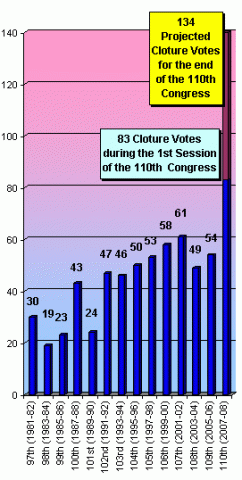
This strategy, paired with a media that loves the "Democrats in disarray" meme, has allowed the Republicans to stop major legislation in the Senate at levels that are historically unprecedented. Here's a comparison of cloture votes over the last 30 or so years:


[This graphic above is from here, but the best history on this is from McClatchy, which continues its tradition of being the only news agency doing its job. We are currently at 127 cloture votes with 5 months left in the session.]

Notice the outlier? This is not a story you'll hear in the media. But it is impossible to understand any vote in the Senate without understanding this strategy.

Which brings me back to today's heating aid bill. The Republicans need 41 votes to hold this bill hostage to offshore drilling concerns -- or more specifically, they need to make sure there are not 60 votes for cloture (cloture requires 3/5 of the Senate to vote Yea, not 3/5 of present Senators).

So what's the strategy here? It's called Catch and Release. The Republican leadership gets all the votes it needs -- 41 people to vote Nay or not show up. Then it hands out passes -- they let certain vulnerable Senators up for reelection vote for the bill (or in this case, possibly Senators from the oil-heated Northeast.). Those passes could theroretically be up to 8 in this session, but it's usually somewhat less.

As long as they don't cut it *too* close they can block the bill and burnish a couple "maverick" crendentials.

So did Sununu get a "catch and release" or not? Did our other Senator, Senator Gregg get one?

Internet tools can tell you that -- but what they can't tell you is that in this case it doesn't matter, that what matters in this case is an overall party strategy which has been used to rule from the minority in a historicaly unprecendented way. And that the money here that matters most is not neccesarily the donations of the industries to the individual campaigns (though, believe me, that matters), but quite possibly the general slush of party senatorial campaign money.

Given that -- what is the best approach to building our emerging digital democracy?

I think it's maybe what we see here. I'm an optimist ultimately -- Jon's discovery regarding where his wood pellet tax credit went *is* significant in the way it personalized the issue -- the specificity of that really brings the issue home. And it's significant in that it showed the media narrative around the issue to be what it is -- a farce.

Those are big and important things. But I think it's also significant in that Jon's post prompted me to post this explanation here, on my personal blog, rather than the progressive venues I'd normally post it to. As more people delve into these tools, the conversation around how our process really works can occur. And hopefully it can start to occur in channels outside the poliwonkablogosphere that I love so much but that others, well, not so much.

The first reaction to tools in the hands of novices is always that the novices don't have the proper context. But use those tools and the context will come to you. Whether you asked for it or not.

Update: I broke down and checked THOMAS. John Sununu, our Senator who is up for re-election this fall, voted for cloture. Judd Gregg, who is up in 2010, did not.

| 12 comments ]

I'm excited beyond words to annouce that starting August 25th I will be working for the OpenCourseWare Consortium as their first Director of Community Outreach. Or at least we think that's the title of the position. This is the job that appeared in OLDaily some time ago as a marketing job.

For me, there's a great bit of serendipty in getting this postion. I started my career in e-learning more than a decade ago, and one of my first projects, back in 1997, was what we'd now term an OER project. In 1999, I convinced my employer to make pre-literacy sofware available free on the internet and we put up some of the first flash-based educational games (if you have younger kids, check the link out, it's still pretty cool stuff). I became enamored with the net-enabled learning-by-doing approach of Cognitive Arts, and was lucky enough to be a senior engineer on the Columbia University Online project 2000-2002.

I've kept up with the issues in net-enabled education, but in more recent years my professional and personal life has been more centered in community organizing and publicity, both in movement politics and for my college. And I've enjoyed that, a lot. I'm frankly probably a better community organizer and media guy than I ever was a programmer (although I do miss the long diet coke filled nights where it's just you, your tunes, and 108 lines of python that need to ship by morning).

I had been looking to get back into the net-enabled learning space more fully, and had made some steps towards that at my own institution, but then this job appeared -- which is essentially community organizing and movement politics (sort of) for the educational issues I care about.

How cool is that? I honestly looked at the ad, and understood for the first time that the two phases of my career didn't have to be separate.

Am I gushing here? Yeah, I guess. I can't help it.

I'll say more about this when I start, but couldn't resist putting up something now. And if you're a reader of this blog and want to tell me what *you* think the OCW movement should be doing, don't hesitate to email me at caulfield dot mike at gmail dot com. No matter what we decide to call this position, outreach is a whole bunch of what it's about, and ultimately that means more listening than talking.

| 0 comments ]

I started to type this as a response to the gracious comment Ismael left me on the Stallman post, but it quickly got big, so I am putting it here:

Ismael writes:

The rationale behind my quote of his about art (not actually a literal quote, but actually faithful to what he said) was that:
- if we’re talking about content/works/software that are needed, as tools, to reach other goals, they should be free
- art did not fall in the previous category
- art, as a subjective expression of one’s ideas/feelings, should not be changed by any means (e.g. Richard M. Stallman would not allow any derivative works of his writings not to go out of context, or find he’s being attributed things he did not actually said ;)


First I want to thank Ismael for taking both the initial time to transcribe this lecture of Stallman, and to clarify it. (And I agree with him that from the point of view of most people, the medical patents statement is the most interesting -- just not my area)

So to the point --

I think the "practical=tool" clarification helps, but ultimately does not rescue Stallman's argument. To me, at least, it embraces a Romantic and Early Modern view of art. And it's a view I've found quite interesting -- I have always thought, for example, that Jakobson's "Poetic Function", which defines art as essentially as a message that turns in on itself -- that is, as a message that does not direct itself toward externalities -- that analysis is one of the genius moments in 20th century intellectual history. I read the lines "the projection of the principle of equivalence from the axis of selection to the axis of combination", his definition of the Poetic, and I'm still stunned at how many threads of modern thought come together in that beautifully simple but stunningly creative insight.

So I'm more than interested in attempts to define Art and aesthetic thinking as something in space apart from the prectical and directed. And tellingly, the other name for the Jakobson's Poetic function it the "autotelic" -- that which is an end in itself -- and this jives nicely with Stallman's distinction. That's not coincidental, since Stallman and Jakobson are pulling from the same Art for Art's Sake influences, but it's significant.

Yet even in 1961, Jakobson saw this as a *function* -- that is, there is no such thing as poetry in a sense -- there's a poetic element in everything. And the things we call poetry and art are traditionally things which are constructed to highlight the relation of the message to itself. But while the function has clear abstract boundaries, the artifacts that function illuminates do not. And we now have about 40 years of post-structuralist theory showing us that is indeed the case.

So back to the point -- to the average person, I suppose, art is not a tool -- because they enjoy it as readers. They revel in the autotelic. But to the artist, new art is always demonstrating ways to solve their own artistic problems. It's no different in some ways than physical invention. Camera obscura, a tool, had a profound effect on Rennaisance Art -- but so did Giotto's realism. To the artist, and even to the astute viewer, art is always a set of tools, characters, plot devices and the like that they can rip out and use.

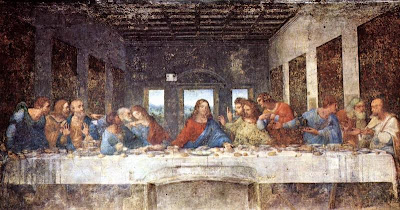
And of course it does not stop there. Fan fiction is a good example, but we don't have to go twentieth century on this...here's DaVinci's Last Supper:


And here's Giampetrino's from some years later:


What was an output of Da Vinci's artistic process becomes an input into Giampetrino's own. It's not the world's most original work, but as long as correct attribution is made, why shouldn't Giampetrino use Da Vinci's work to develop his own style?

Similarly, many of my wife's friends use photos taken by someone else to make paintings from. To the photographer, the photograph may be meant to be autotelic, but to the painter who uses it, it is another tool in completing their own ends. Likewise, the painting one creates from the photograph could end up as a piece of website layout, or the background of a WordPress theme.

There's a solution to this, but Stallman can't use it. The solution is to say that the photographer gets to decide whether his photographs are meant to be tools for graphic designers and artists (in which case he gives up his freedom) or art (in which case he preserves his rights).

But that rests the division in the intentionality of the producer, not in any attribute of the object. And if we vest that distinction in intentionality, we might as well all go home -- to say that the producer should determine how his own work should be used is to say that the concept of Free Software is dead. I choose to see my code as my personal self-expression, therefore you can't copy it.

That's where we were *before* Stallman's innovative movement, and I have no intention of going back.

I don't mean to minimize the massive problems in Art here, with everything from compensation to attribution. It's not an easy subject -- it's far more difficult than coming to terms with whether printer drivers should be free and open. And I'm guessing that's why Stallman wants to wall it off from his more core concerns.